Comparing Being Born Again to Butterflies
Tin the legacy of trauma be passed down the generations?
(Paradigm credit:
Alamy/Getty Images/BBC
)
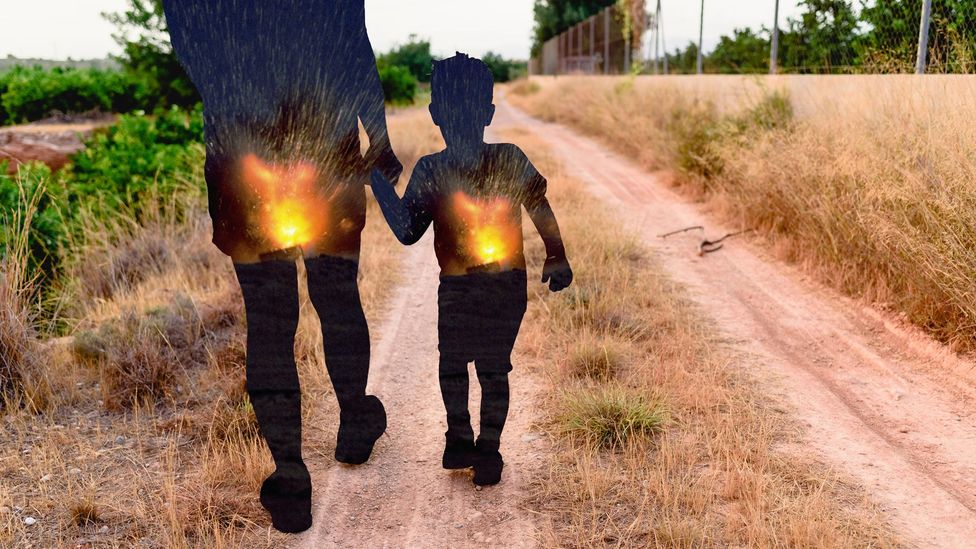
Our children and grandchildren are shaped by the genes they inherit from us, merely new research is revealing that experiences of hardship or violence can go out their mark too.
I
In 1864, nearing the stop of the US Civil War, conditions in the Amalgamated pw camps were at their worst. There was such overcrowding in some camps that the prisoners, Spousal relationship Ground forces soldiers from the n, each had the square footage of a grave. Prisoner death rates soared.
For those who survived, the harrowing experiences marked many of them for life. They returned to society with impaired health, worse job prospects and shorter life expectancy. Simply the impact of these hardships did non stop with those who experienced information technology. It also had an outcome on the prisoners' children and grandchildren, which appeared to be passed down the male line of families.
While their sons and grandsons had non suffered the hardships of the PoW camps – and if anything were well provided for through their childhoods – they suffered higher rates of mortality than the wider population. It appeared the PoWs had passed on some element of their trauma to their offspring.
You might as well like:
• What happens when the food runs out?
• Wet countries that are running dry
• Why more than men take their own lives
But dissimilar most inherited weather condition, this was not caused past mutations to the genetic code itself. Instead, the researchers were investigating a much more than obscure type of inheritance: how events in someone's lifetime can change the way their Deoxyribonucleic acid is expressed, and how that change can be passed on to the next generation.
This is the procedure of epigenetics, where the readability, or expression, of genes is modified without changing the DNA code itself. Tiny chemical tags are added to or removed from our DNA in response to changes in the environment in which we are living. These tags turn genes on or off, offering a way of adapting to changing conditions without inflicting a more than permanent shift in our genomes.
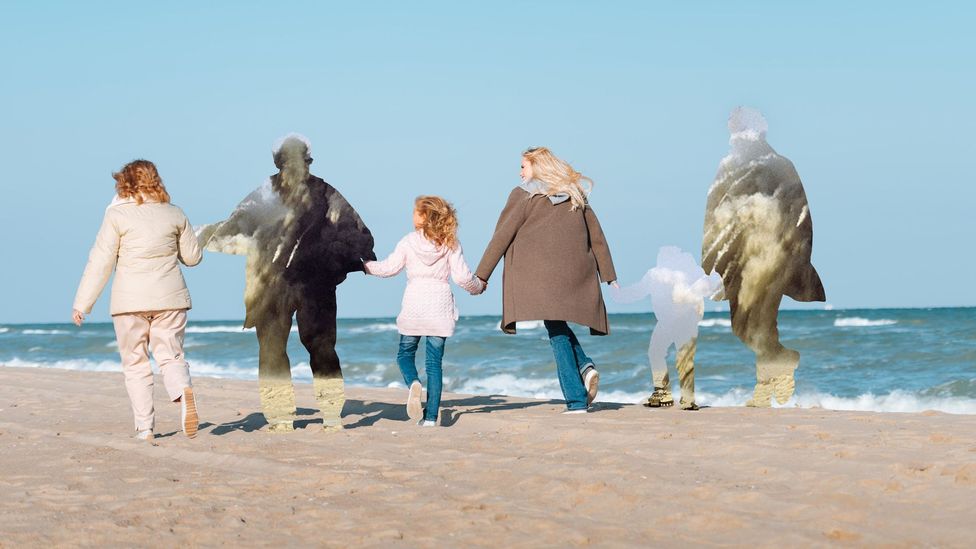
The furnishings of trauma may echo down several generations, from a granddad to their son and then to their grandson (Credit: Alamy/Getty Images/BBC)
Merely if these epigenetic changes caused during life tin indeed besides be passed on to later generations, the implications would be huge. Your experiences during your lifetime – particularly traumatic ones – would have a very existent impact on your family for generations to come. In that location are a growing number of studies that support the idea that the effects of trauma can reverberate downward the generations through epigenetics.
For the PoWs in the Confederate camps, these epigenetic changes were a result of the extreme overcrowding, poor sanitation and malnutrition. The men had to survive on small-scale rations of corn, and many died from diarrhoea and scurvy.
"In that location is this period of intense starvation," says study author Dora Costa, an economist at the Academy of California, Los Angeles. "The men were reduced to walking skeletons."
Costa and her colleagues studied the health records of nearly 4,600 children whose fathers had been PoWs, comparing them to just over 15,300 children of veterans of the war who had not been captured.
The sons of PoWs had an 11% higher mortality rate than the sons of non-Prisoner of war veterans. Other factors such equally the begetter's socioeconomic status and the son's chore and marital status couldn't account for the higher mortality rate, the researchers found.
This excess mortality was mainly due to higher rates of cerebral haemorrhage. The sons of PoW veterans were as well slightly more than probable to dice from cancer. But the daughters of former PoWs appeared to exist immune to these effects.
This unusual sex-linked pattern was i of the reasons that made Costa doubtable that these health differences were acquired by epigenetic changes. Only first Costa and her team had to rule out that information technology was a genetic effect.

For some reason, the trauma seem to be virtually strongly passed from fathers to their sons (Credit: Alamy/Getty Images/BBC)
"What could have happened is that a genetic trait which enabled the father to survive the military camp, a tendency toward obesity for example, was then bad during normal times," says Costa. "Nonetheless, if you await within families, there are only effects among sons born after but non before the war."
If it were a genetic trait then children built-in before and after the war would be equally likely to show the reduced life expectancy. With a genetic cause ruled out, the most plausible explanation left was an epigenetic effect.
"The hypothesis is that there'south an epigenetic effect on the Y chromosome," says Costa. This result is consequent with studies in remote Swedish villages, where shortages in food supply had a generational effect down the male line, merely not the female person line.
But what if this increased take a chance of death was due to a legacy of the father's trauma that had nothing to do with Dna? What if traumatised fathers were more likely to abuse their children, leading to long-term health consequences, and sons diameter the brunt of information technology more than daughters?
Once once more, comparing the wellness of children inside families helped dominion this out. Children born to men before they became PoWs didn't have a spike in bloodshed. But the sons of the same men afterward their PoW camp experience did.
"It's a case of ruling out the other possible options," says Costa. "A lot of it is proof by elimination and what is the most consistent explanation."
Many of the times when trauma is thought to have echoed downward the generations via epigenetics in humans are linked to the darkest moments in history. Wars, famines and genocides are all thought to have left an epigenetic mark on the descendants of those who suffered them.
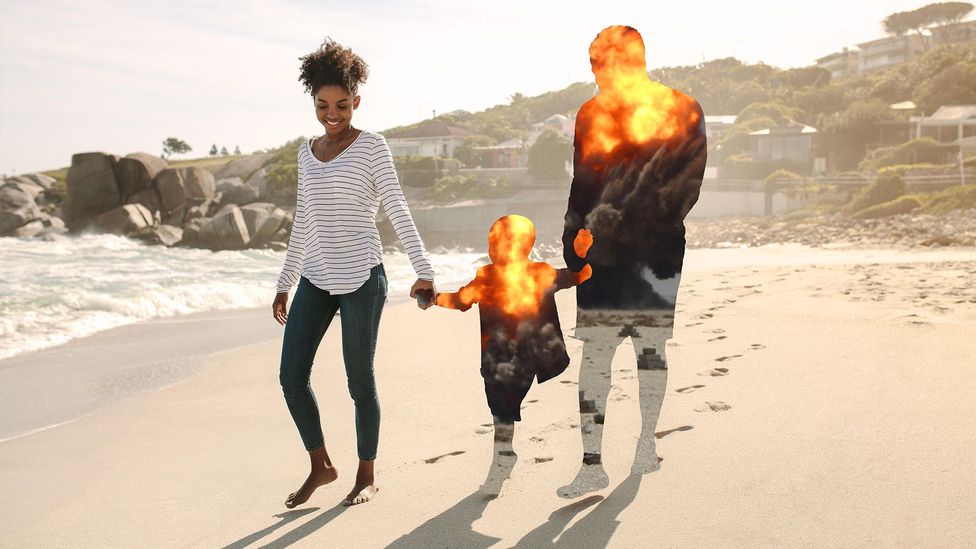
An epigenetic point in the children of people who have survived traumatic experiences raises hopes of reversing the event it has on their Dna (Credit: Alamy/Getty Images/BBC)
Some studies have proved more controversial than others. A 2015 study found that the children of the survivors of the Holocaust had epigenetic changes to a gene that was linked to their levels of cortisol, a hormone involved in the stress response.
"The idea of a signal, an epigenetic finding that is in offspring of trauma survivors can mean a lot of things," says Rachel Yehuda, director of the Traumatic Stress Studies Division at the Mount Sinai School of Medicine and an author of the report. "It's heady that it's there."
The study was pocket-size, assessing but 32 Holocaust survivors and a full of 22 of their children, with a small control grouping. Researchers accept criticised the conclusions of the study. Without looking at several generations and searching more than widely in the genome, we tin can't be sure it is actually epigenetic inheritance.
Yehuda acknowledges that the paper was diddled out of proportion in some reports, and larger studies assessing several generations would be needed draw firm conclusions.
"Information technology was i single small study, a cross-section of adults many, many years after parental trauma. The fact we got a hint was big news," says Yehuda. "Now the question is, how do you lot put meat on the bones? How do y'all really understand the mechanism of what is happening?"
Controlled experiments in mice accept allowed researchers to strop in on this question. A 2013 study establish that there was an intergenerational effect of trauma associated with olfactory property. The researchers blew acetophenone – which has the scent of ruby-red blossom – through the cages of developed male mice, zapping their foot with an electrical current at the same time. Over several repetitions, the mice associated the aroma of cherry blossom with pain.
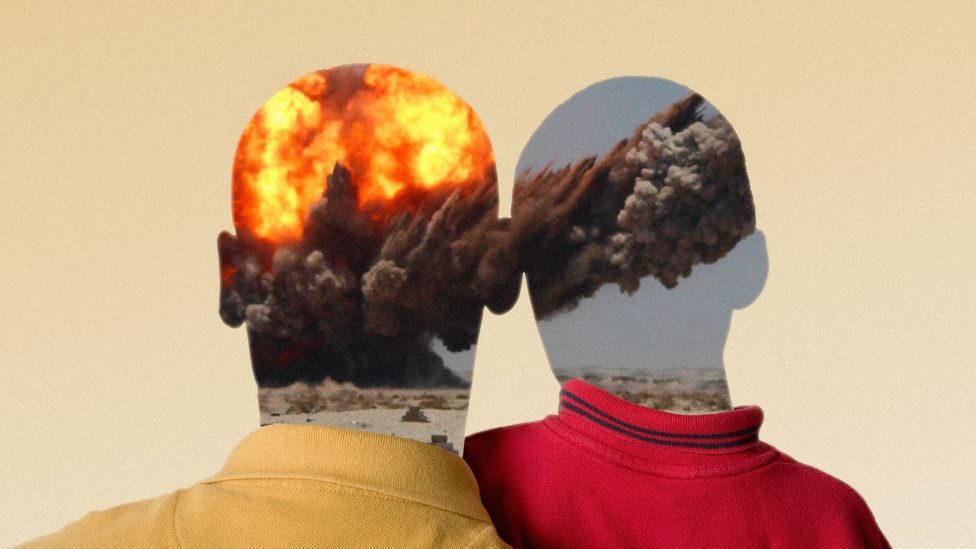
The idea that the issue of a traumatic experience might exist passed from a parent to their offspring is still regarded as controversial by many (Credit: Alamy/Getty Images/BBC)
Presently afterwards, these males bred with female mice. When their pups smelled the scent of crimson blossom, they became more jumpy and nervous than pups whose fathers hadn't been conditioned to fear information technology. To dominion out that the pups were somehow learning about the smell from their parents, they were raised by unrelated mice who had never smelt cherry blossom.
The grandpups of the traumatised males also showed heightened sensitivity to the odour. Neither of the generations showed a greater sensitivity to smells other than cherry blossom, indicating that the inheritance was specific to that odor.
This sensitivity to reddish bloom olfactory property was linked dorsum to epigenetic modifications in their sperm Dna. Chemic markers on their DNA were found on a cistron encoding a olfactory property receptor, expressed in the olfactory bulb between the nose and the brain, which is involved in sensing the cherry flower odor. When the squad dissected the pups' brains they likewise found there was a greater number of the neurons that detect the red blossom scent, compared with control mice.
The second and third generation appeared to take not a fear of the scent itself, just a heightened sensitivity to it. The finding brings to light an oft-missed subtlety of epigenetic inheritance – that the next generation doesn't always show exactly the aforementioned trait that their parents developed. It is not that fearfulness is being passed down the generations – information technology is that fearfulness of a scent in one generation leads to sensitivity to the aforementioned scent in the next.
"So this is non 'apples for apples'," says Brian Dias, author of the study and a researcher at Emory University and the Yerkes National Primate Research Middle in the U.s.. Even the term "inheritance" should be qualified here, he adds. "The word inheritance suggests it has to exist a faithful representation of a trait that's passed down."
The consequences of passing down the effects of trauma are huge, even if they are subtly contradistinct betwixt generations. It would change the way we view how our lives in the context of our parents' feel, influencing our physiology and even our mental wellness.

The offspring of mice condititioned to fear the smell of flowers would also be sensitive to the same scent (Credit: Alamy/Getty Images/BBC)
And knowing that the consequences of our own actions and experiences now could affect the lives of our children – even long before they might be conceived – could put a very unlike spin on how we cull to live.
Despite picking up these echoes of trauma down the generations, there is a large stumbling block with research into epigenetic inheritance: no i is sure how it happens. Some scientists think that it is actually a very rare event.
I of the reasons that it may not be widespread is that the vast majority of ane type of epigenetic mark on the Dna – the addition of a clump of chemicals known every bit methylation – is wiped clean at the very start of life and the process of adding these chemical groups to the DNA begins almost from scratch.
"As soon as the sperm enters the egg in a mammal, there's a rapid loss of DNA methylation from the paternal set of chromosomes," says Anne Ferguson-Smith, a researcher studying epigenetics at the University of Cambridge. "That'due south the reason why transgenerational epigenetic inheritance is such a surprise.
"It's very hard to imagine how you could accept epigenetic inheritance when there's a process of removal of all the epigenetic marks and putting on new ones in the next generation."
At that place are, however, parts of the genome that are not wiped clean. A process chosen genomic imprinting protects the methylation at specific points of the genome. But these sites are not the ones where the epigenetic changes relevant to trauma are found.
A contempo study past Ferguson-Smith's grouping suggests epigenetic inheritance is probably very rare in mice.
Epigenetics is thought to be the link between nature and nurture, where a person's experiences alters how their DNA is read past their cells (Credit: Alamy/Getty Images/BBC)
But other researchers are convinced that they have found the hallmarks of epigenetic inheritance for several traits – in humans too every bit animals. What's more, they call up they've institute a mechanism for how information technology works. This time it could be molecules similar to DNA – known as RNA – that are altering how genes part.
A recent paper has revealed potent evidence that RNA may play a role in how the effects of trauma tin can be inherited. Researchers examined how trauma early in life could exist passed on by taking mouse pups away from their mothers right afterwards nascency.
"Our model is quite unique," says Isabelle Mansuy of the University of Zürich and ETH Zürich, who led the research. "It'southward to mimic dislocated families, or the abuse, fail and emotional damage that you sometimes meet in people."
The symptoms these pups showed as they grew up too mimicked the symptoms seen in children who have experienced early on trauma. The mice showed signs of increased run a risk-taking and higher calorie intake, both seen in kid trauma survivors. When the males grew up, they had pups that showed similar traits – overeating, adventure taking and higher levels of antisocial behaviour.
The researchers extracted RNA molecules from the sperm of male mice who had been traumatised and injected these molecules into early the embryos of mice whose parents had not experienced this early-life trauma. The resulting pups, however, showed the typical contradistinct behavioural patterns of a pup whose parents experienced trauma.
They also found that dissimilar lengths of RNA molecules were linked to different behavioural patterns: longer RNAs corresponded to greater food intake, changed the body'due south response to insulin and greater risk-taking. Smaller RNA molecules were linked to showing signs of despair.
"Information technology's the first time nosotros've seen this link in a causal style," says Mansuy.
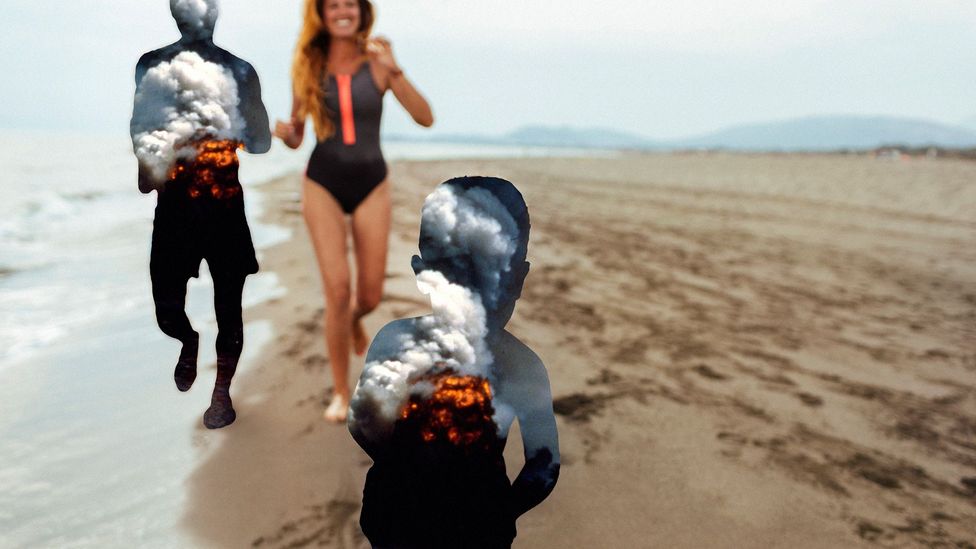
It is possible that emotional damage experienced in your own childhood could be passed on to your children (Credit: Alamy/Getty Images/BBC)
How these RNA molecules alter the behaviour of multiple generations is not all the same known. Mansuy is now running experiments in humans to encounter if similar processes are at piece of work in humans. Initial experiments by other researchers have shown that this does seem to be the case in men.
This research – as well as many of the mice studies – focus on sperm and epigenetic inheritance down the male line. This isn't considering scientists think it just happens in males. It's just a lot harder to study eggs than it is to written report sperm.
Just efforts to decipher epigenetic inheritance downwardly the female line is the adjacent step.
"We had to beginning from somewhere," says Mansuy. "Just we are looking to accept a model of trauma that shows how inheritance occurs via both females and males."
There are other known kinds of epigenetic mechanisms that are relatively little studied. 1 of them is chosen histone modification, where the proteins that deed every bit a scaffold for DNA are chemically tagged. Now enquiry is starting to suggest that histones could besides be involved in epigenetic inheritance through the generations in mammals.
"I suspect the answer is that all of these mechanisms could collaborate to give us the miracle that is intergenerational inheritance of acquired traits," says Dias.
The science of epigenetic inheritance of the furnishings of trauma is young, which means it is still generating heated debate. For Yehuda, who did pioneering work on Post-Traumatic Stress Disorder in the 1990s, this comes with a sense of déjà vu.
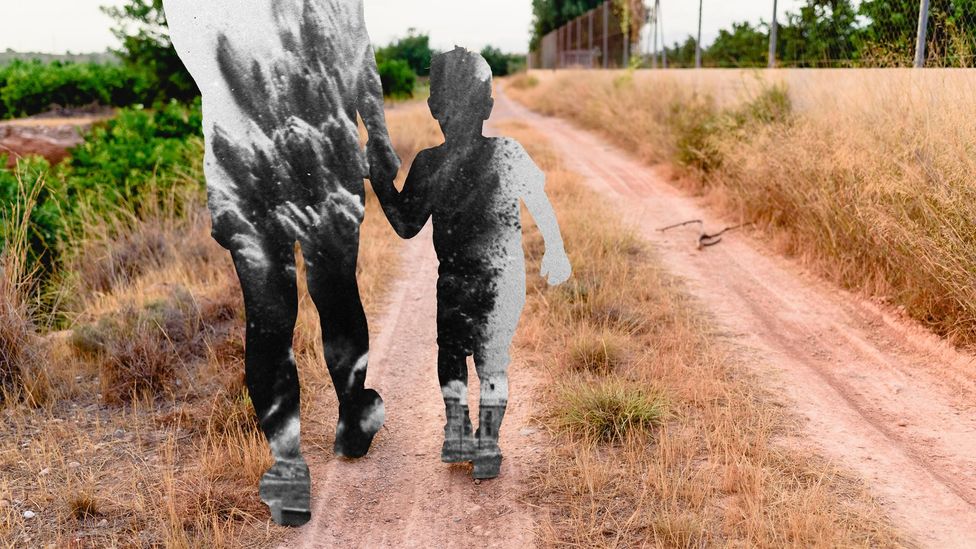
Exactly how trauma is passed down through the generations is still unclear equally the mechanisms that act on the DNA are not fully understood (Credit: Alamy/Getty Images/BBC)
"Where we are with epigenetics today feels like how it was when we beginning started doing research into PTSD," she says. "It was a controversial diagnosis. Non anybody believed there could exist long term outcome of trauma."
Almost xxx years later, PTSD is a medically accepted condition that explains why the legacy of trauma can span decades in a person'south lifetime.
But if trauma is shown to be passed down the generations in humans in the same style as it appears to exist in mice, we shouldn't feel a sense of inevitability about this inheritance, says Dias.
Using his carmine blossom experiments in mice, he tested what would happen if males that feared the scent were later desensitised to the odour. The mice were repeatedly exposed to the scent without receiving a human foot shock.
"The mouse hasn't forgotten, but a new association is being formed now this odour is no longer paired with the human foot shock," says Dias.
When he looked at their sperm, they had lost their feature "fearful" epigenetic signature later the desensitisation process. The pups of these mice also no longer showed the heightened sensitivity to the odor. So, information technology if a mouse "unlearns" the association of a odour and pain, then the adjacent generation may escape the effects.
It also suggests that if humans inherit trauma in similar ways, the effect on our Deoxyribonucleic acid could be undone using techniques similar cognitive behavioural therapy.
"At that place's a malleability to the arrangement," says Dias. "The die is not bandage. For the most part, we are not messed upwards as a human race, even though trauma abounds in our environment."
At least in some cases, Dias says, healing the effects of trauma in our lifetimes can put a stop to it echoing farther downward the generations.
--
The artworks in this commodity were created by Javier Hirschfeld for the BBC.
Join 900,000+ Future fans by liking us on Facebook , or follow us on Twitter or Instagram .
If you liked this story, sign upward for the weekly bbc.com features newsletter , called "If You Just Read vi Things This Calendar week". A handpicked selection of stories from BBC Time to come, Culture, Capital letter, and Travel, delivered to your inbox every Friday.
Source: https://www.bbc.com/future/article/20190326-what-is-epigenetics
0 Response to "Comparing Being Born Again to Butterflies"
Post a Comment